
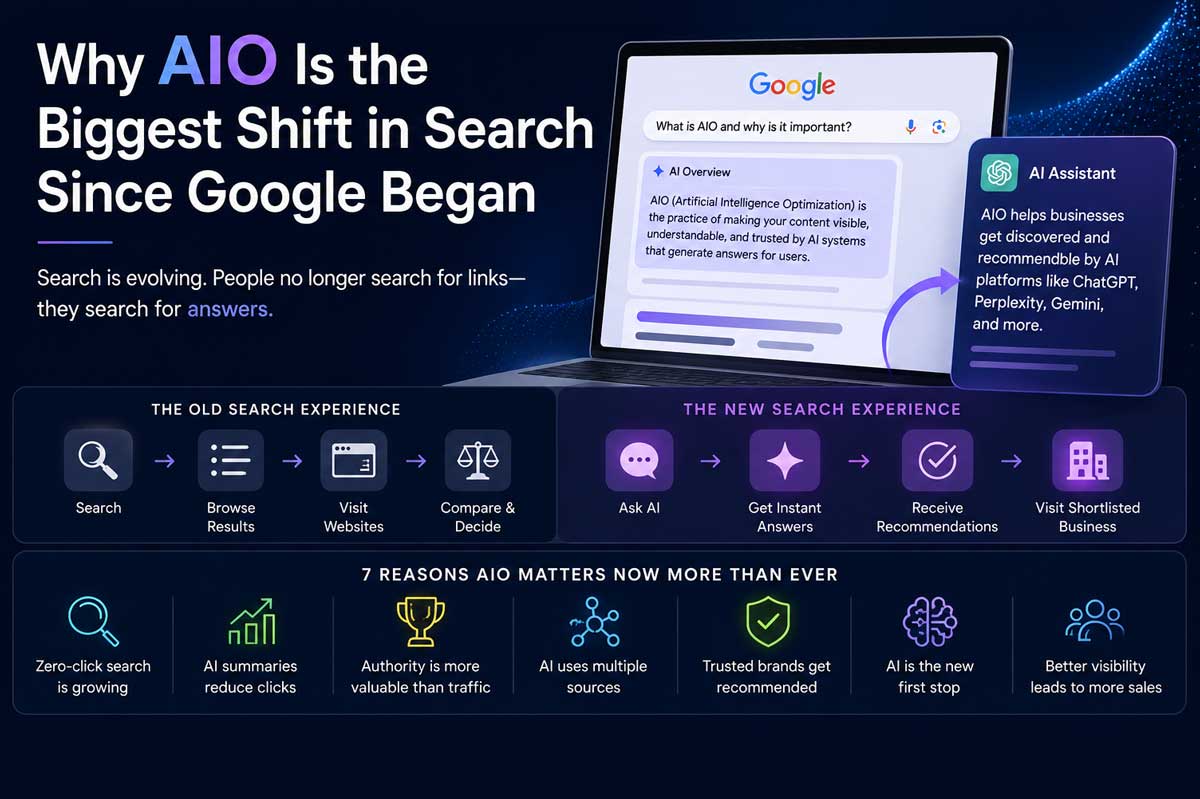
For more than twenty years, search engine optimization has followed the same basic pattern: someone searches, Google returns a list of links, and the strongest websites earn the click. That formula built entire industries — and for a long time, it worked.
It’s breaking down now, faster than most businesses realize.
Increasingly, people get answers without ever leaving the search engine, and sometimes without using a traditional search engine at all. Google’s AI Overviews, ChatGPT, Perplexity, Gemini, Claude, and a growing list of AI assistants are changing how people find information in the first place. That shift is why businesses need to think beyond SEO and start paying attention to Artificial Intelligence Optimization, or AIO.
Most marketers hear “AIO” and assume it’s just SEO with an AI twist. That’s only half right. The bigger change is behavioral: people aren’t browsing websites to find answers anymore. They expect the answer to come to them directly.
Search Has Become Answer Discovery
Search used to be about exploration. Someone would type “what’s the best CRM for a small business,” get ten blue links, and spend the next twenty minutes comparing sites, reading reviews, and watching demo videos before deciding.
That’s not really how it works anymore. Google often shows an AI-generated summary before any organic result appears. ChatGPT might answer the question outright, with no search results in sight. Perplexity builds a sourced, researched response. Voice assistants just say the answer out loud.
In a lot of cases, people get enough information to move on without visiting a single website — Google itself has described AI Overviews this way: synthesizing answers while still linking out to supporting sources. This isn’t a minor search feature. It’s a different way of consuming information altogether.
The Rise of Zero-Click Search
“Zero-click search” isn’t a new term — featured snippets, knowledge panels, and local packs have been chipping away at click-throughs for years. AI has just sped that trend up considerably.
Instead of digging through multiple pages, people now often get complete explanations, product comparisons, step-by-step instructions, summaries, and recommendations before they ever land on your site. Research increasingly points to AI summaries reducing click-through rates on informational searches, which means being cited as a trusted source now matters more than ranking well on its own.
Visibility, in other words, is starting to outweigh rankings.
SEO Isn’t Dead — It’s Changing Jobs
People declare SEO dead every few years, and they’re always wrong. AI systems still rely on high-quality content to learn from and cite, and pages that already rank well organically tend to show up in AI Overviews too — they’re just no longer the only sources AI pulls from.
But SEO on its own isn’t enough anymore. Optimizing purely for rankings ignores how people are actually finding information today. The question worth asking isn’t just “how do we rank #1?” It’s “will AI actually mention us when someone asks about our industry?” That’s a different problem, and it needs a different strategy.
What Artificial Intelligence Optimization Actually Means
AIO is about making your business easy for AI systems to understand, trust, and reference — not just easy for search engines to find. That means content that’s clearly structured, factually accurate, well-sourced, consistently branded, and genuinely useful, rather than written for keyword density.
Think of it this way: SEO helps Google find your pages. AIO helps AI understand your business. One builds on the other — AIO doesn’t replace SEO, it extends it.
Authority Is Starting to Matter More Than Traffic
Digital marketing has traditionally been measured in rankings, visitors, click-through rate, and organic sessions. Those numbers still count. But AI is adding a new one to the list: citation.
If Google’s AI Overview recommends your company, if ChatGPT references your research, if Perplexity links to your article, your brand gains authority even when fewer people click through right away. Businesses that consistently show up as trusted sources are building visibility across every AI platform at once, not just Google.
Increasingly, the competition isn’t for the #1 spot. It’s to become the source AI actually trusts.
A Shorter Customer Journey
The old customer journey looked like this: search, browse a few websites, compare, then contact. It’s starting to look more like this instead: ask AI, get a recommendation, visit the company that made the shortlist.
Notice what disappeared — the five or six competitor sites someone used to compare. Consumers are increasingly working from a shortlist AI built for them. If your business isn’t on that list, you may never get the chance to compete for the business at all.
What Businesses Should Be Doing Right Now
Waiting for AI search to “settle down” isn’t a strategy — the businesses gaining visibility today are already adjusting. A few priorities worth focusing on:
- Publish real expertise. Generic, keyword-driven content is losing value fast. AI models favor content that demonstrates genuine knowledge and original thinking.
- Build topical authority. A handful of deep, comprehensive resources around your core services will do more than a hundred scattered blog posts. Depth beats volume.
- Strengthen your brand as an entity, not just a website. AI doesn’t only look at your pages — it evaluates you as an entity, so mentions across reputable publications, directories, and industry sources matter.
- Make your content easy for machines to read. Clear headings, logical structure, FAQs, and schema markup all help AI interpret your content correctly. Google’s own guidance is to write for people first, not to game AI systems.
- Keep investing in SEO fundamentals. Technical SEO, page speed, accessibility, and quality backlinks aren’t going anywhere. AIO builds on these, it doesn’t replace them.
This Isn’t Just About Google
One of the most common mistakes businesses make is treating AIO as a Google AI Overviews problem. It’s much bigger than that. People are asking questions across ChatGPT, Claude, Gemini, Perplexity, Microsoft Copilot, voice assistants, and AI-powered browsers — and each of these systems finds, interprets, and presents information differently. Optimizing for one platform isn’t enough; this requires a broader visibility strategy.
The Future Belongs to Trusted Brands
The web is in its next chapter. Websites used to compete for rankings. Now they’re competing for recommendations — a much higher bar that demands real expertise, clear communication, and consistent authority.
The businesses that invest in this now won’t just adapt to the shift — they’ll become the sources AI recommends.
Final Thoughts
AIO isn’t replacing SEO — it’s expanding what SEO has to accomplish. The organizations that succeed over the next decade won’t just have the best rankings; they’ll have the most trust. As AI becomes many people’s first stop for information, the goal isn’t just to show up in search results anymore. It’s to become the answer.
How Page Agency Can Help
At Page Agency, we believe the future of digital visibility goes beyond traditional SEO. We help businesses build the technical foundations, authoritative content, and digital trust signals needed to perform across both search engines and AI-powered platforms.
Whether your customers are searching on Google, asking ChatGPT, or using whatever comes next, the goal stays the same: make sure your business is the one they find — and the one they trust.
Want to know how we help businesses prepare for the future of search? Get in touch.